IEEE Internet of Things Journal · Journal article · 2026
Authors: Chao Dong, Bo Chen, Wei Wang, Hongtao Liang, Jiahao You, Fuhui Zhou, Haipeng Dai, Qihui Wu
Published in: IEEE Internet of Things Journal, vol. 13, no. 15, pp. 34523–34533, Aug. 2026.
Authorship: Coauthor / 合作作者
DOI: 10.1109/JIOT.2026.3697487
Research overview
This article introduces networked embodied intelligence as a framework for coordinating physical activity and network operation in low-altitude intelligent networks.
The problem
Physical entities and network services can evolve separately, making real-time adaptation difficult. Heterogeneous sensing, computing, communication, and navigation resources also lack a unified coordination structure.
The approach
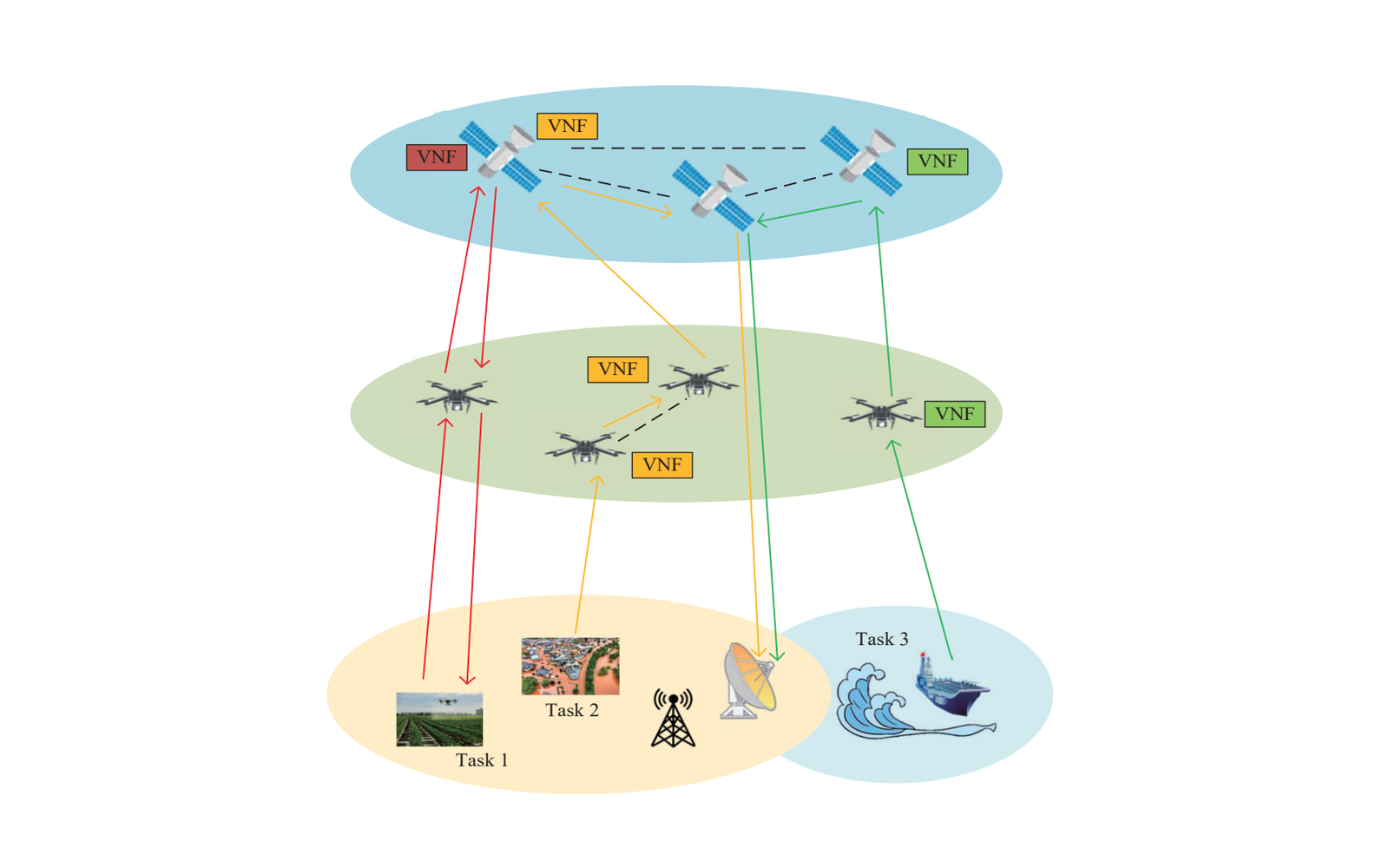
A network-level sensing–decision–action–feedback loop links physical and network states. Four collaborative subnetworks organize sensing, computing, communication, and navigation within the NEI-LAIN architecture.
Evaluation
Simulations examine communication robustness, resource utilization, and task responsiveness in dynamic scenarios. The article also discusses implementation challenges and future research directions.
面向低空智联网的网络化具身智能:范式与架构
本文提出网络化具身智能范式,用于协调低空智联网中的物理活动与网络运行。
研究问题
物理实体与网络服务可能各自变化,难以实现实时协同。感知、计算、通信与导航资源的异构性,也增加了统一协调的难度。
研究方法
论文以网络级“感知—决策—行动—反馈”闭环连接物理和网络状态,并在 NEI-LAIN 架构中组织感知、计算、通信与导航四类协同子网。
研究评估
论文在动态场景下通过仿真考察通信鲁棒性、资源利用和任务响应,并讨论实现挑战与后续研究方向。
中文题名为便于阅读所作的译名,正式引用请使用英文原题。
Citation
[1] C. Dong et al., “Networked embodied intelligence for low-altitude intelligent network: Paradigm and architecture,” IEEE Internet Things J., vol. 13, no. 15, pp. 34523–34533, Aug. 2026, doi: 10.1109/JIOT.2026.3697487.